Our Favorite Career Pages 2026
Anyone can say they move fast and care about people. These five career pages actually show it. Volume 2 of our favorite career pages, and what they get right.
Six months ago, we shared some of our favorite career pages.
We looked at Superside, Pleo, Spotify, Sana, Oatly and Voi, and they all had one thing in common. They knew exactly who they were, who they wanted to attract, and they weren’t trying to be for everyone. And since then, we’ve looked at a lot more career pages.
If there’s one thing the best ones are getting right, it’s this: they don’t just tell you what it’s like to work there, but they show you.
Anyone can write that they move fast, care about people or give employees ownership. The harder part is making a candidate actually understand what those things mean before they’ve even applied. And these five do that particularly well.
Linear
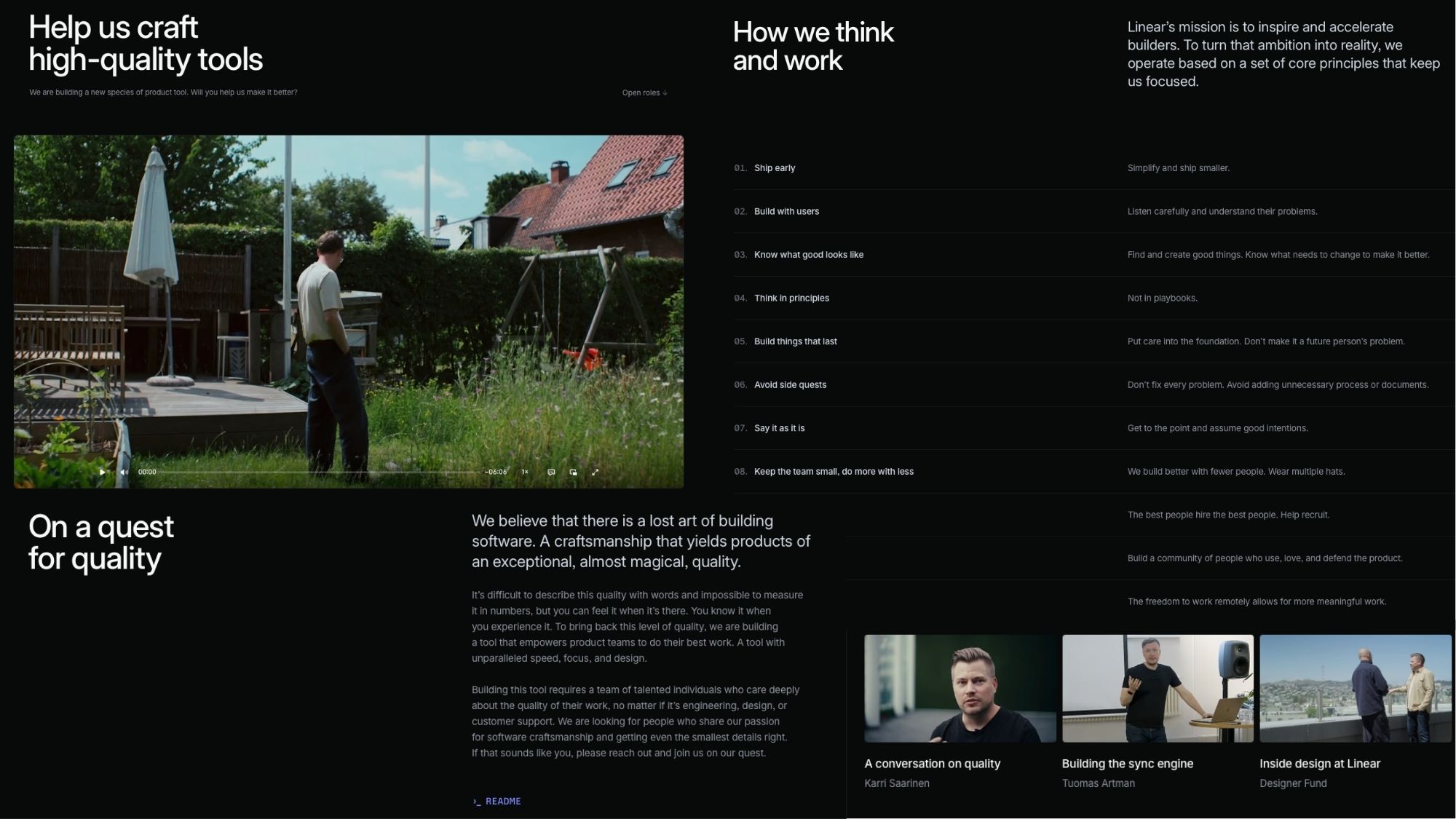
Linear has somehow made restraint feel like an employer branding strategy.
There’s no enormous library of employee stories or endless list of reasons to join. Instead, the page revolves around one thing: quality.
Linear talks about craftsmanship, attention to detail and building things that last. Then it gets surprisingly specific about how that translates into work: ship early, avoid side quests, say it as it is, keep the team small and do more with less. It tells you a lot about the environment without needing to tell you how amazing the environment is, and that's what we like about it.
A career page doesn’t need to answer every possible question, but it needs to make the important things unmistakably clear.
Linear knows what kind of people it wants, and the page is built accordingly.
Canva

At the other end of the spectrum is Canva.
Canva hasn’t really built a career page, but rather an entire employer brand ecosystem. Candidates can explore teams, locations, culture, benefits, belonging, career development, the hiring process and stories from people across the company. There’s enough there to spend a considerable amount of time figuring out what working at Canva might actually look like.
But what makes it work isn't simply the amount of content. It’s that the content goes deeper than the usual claims as Canva explains how growth works, how people are developed, what different teams actually do and how its values show up in the company.
For a company operating at Canva's scale, that's important. One generic EVP has to speak to engineers in Sydney, salespeople in London and marketers on the other side of the world. Instead of trying to squeeze all of that into one page, Canva lets candidates find the version of the story that is relevant to them.
Sometimes a career page shouldn't really be a page at all.
VEED
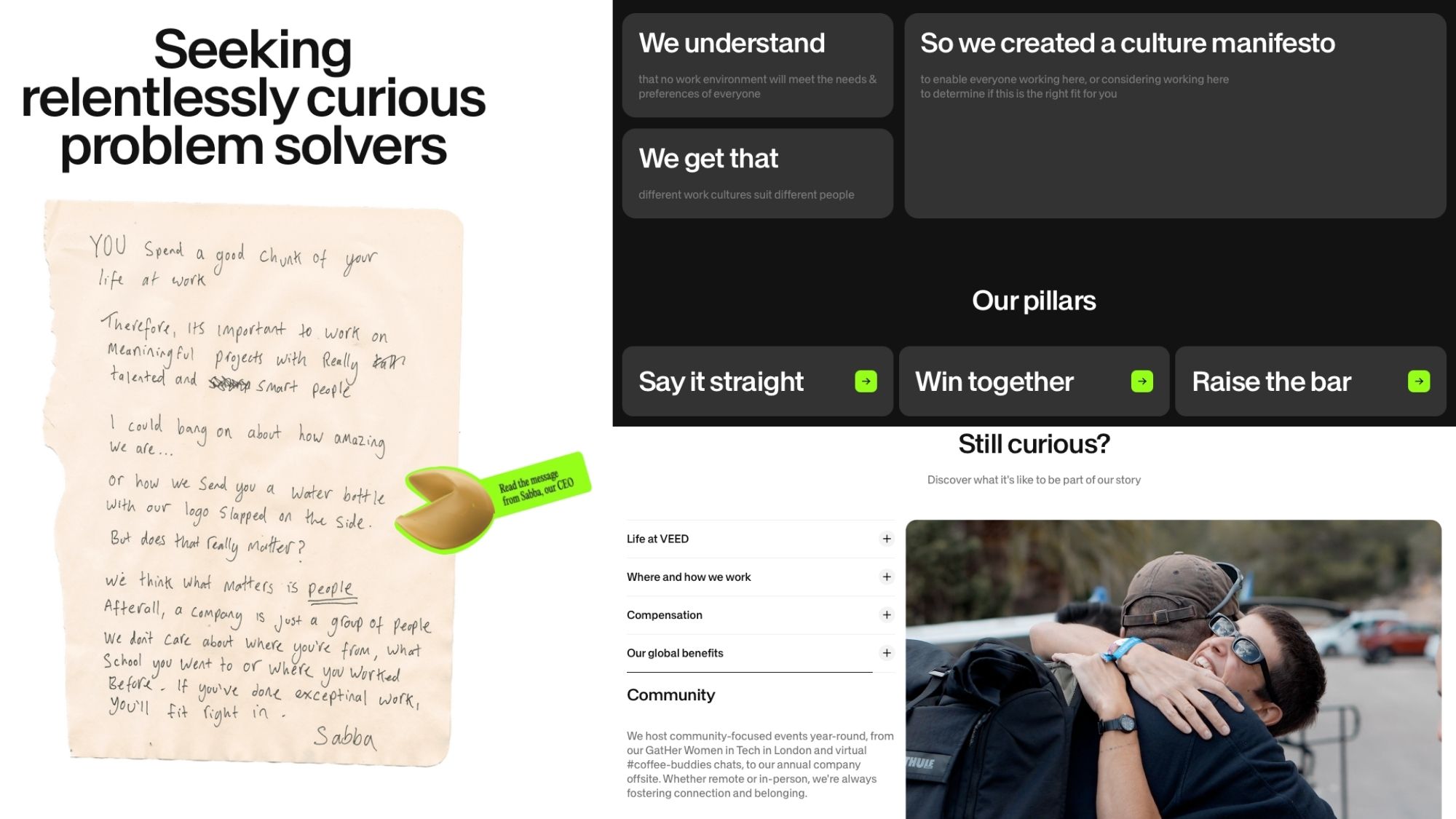
VEED gets something right that more companies should probably be brave enough to say: No work environment works for everyone.
Rather than trying to make its culture universally appealing, VEED gives candidates a culture manifesto designed to help them decide whether they actually belong there. Its pillars are simple: say it straight, win together and raise the bar. The rest of the page builds on them with a pretty clear picture of the environment that consists of autonomy, curiosity, uncertainty, ambition and high expectations.
That makes the career page useful in both directions, because the job of employer branding isn't to make as many people as possible want to work for you. It's to make the right people want to work for you, while giving everyone else enough information to decide that it probably isn't for them.
Good career pages attract, but the great ones filter too.
Eucalyptus

Eucalyptus does a particularly good job of answering a question candidates increasingly care about: What will I actually get to work on?
Instead of keeping everything at the level of mission statements, Eucalyptus shows real projects its teams have worked on, from its Juniper mobile app and health coaching technology to work influencing healthcare policy. That makes a big mission like reshaping healthcare much easier to believe.
The people behind the work are visible too, alongside the company's values, offices, benefits and employee perspectives. And the values themselves are refreshingly specific. “Patients first”, “build in the open, together” and “lean into discomfort” tell you more than another variation of integrity, teamwork and innovation ever could. It connects the big company story to the actual work.
Because candidates don't join mission statements. They join companies, teams and problems they want to spend their time solving.
Implement Consulting Group
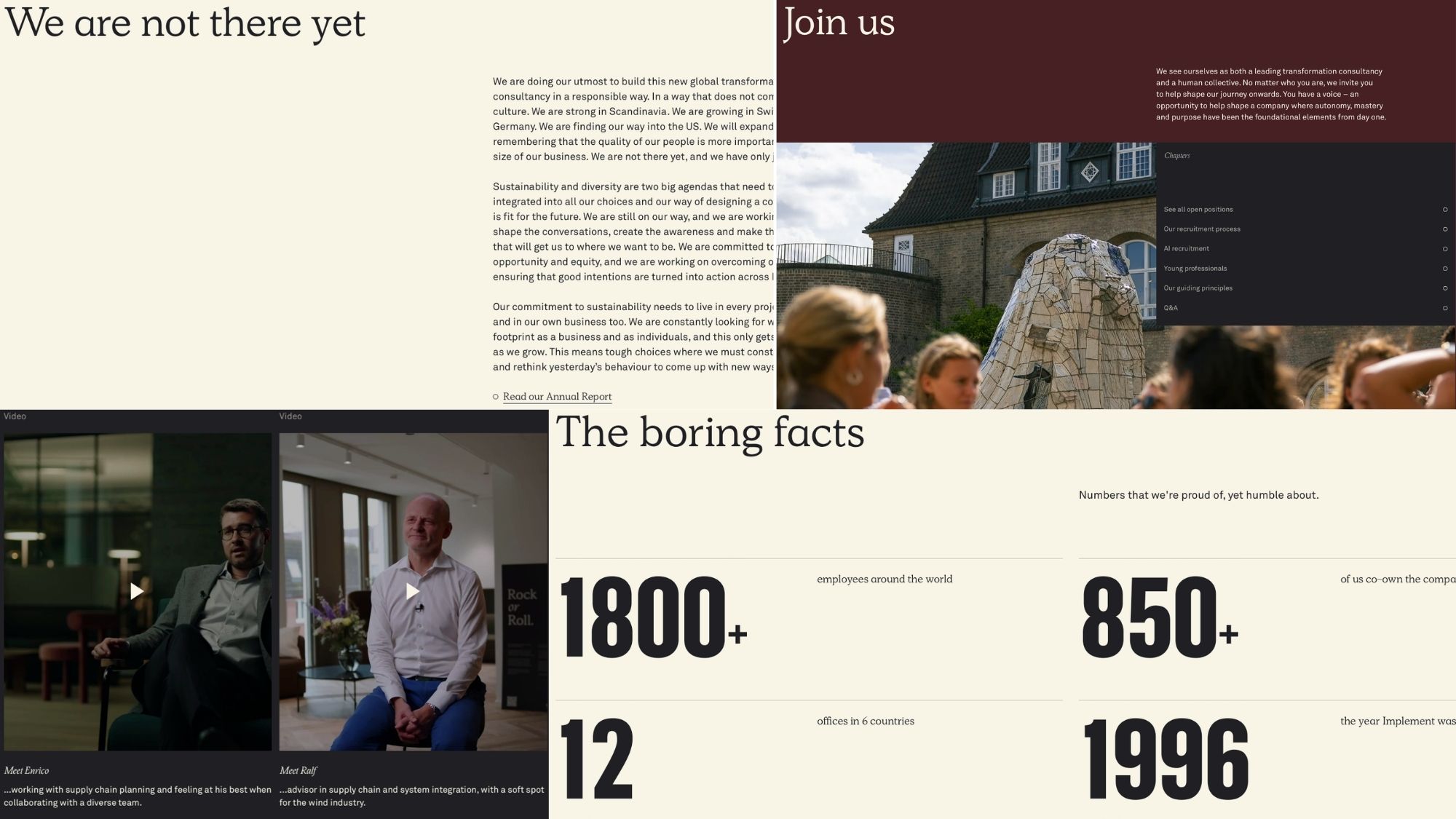
Implement could easily have fallen into the consulting career page trap.
Smart people, challenging projects, great development opportunities, global clients, you know the drill.
Instead, it spends a surprising amount of time explaining how the company actually works. Implement describes itself as a “humanocracy” based on merit, where people can lead from anywhere and progression isn't built around fighting your way up a narrow career ladder. It talks openly about autonomy, mastery and purpose, and takes candidates through what they can expect from the recruitment process.
Even the language around who they want is distinctive. They talk about looking for analytical dreamers and practical visionaries - people who think independently but work collaboratively. Whether that sounds exactly like you or absolutely not like you is almost beside the point.
You understand what they mean. And that's far more valuable than another careers page telling you its people are its greatest asset.
So, what changed?
When we wrote Volume 1, the pattern was identity. The strongest career pages knew who they were and weren't afraid to show it, and we still think that's true.
But this time around, something else stood out: specificity. Linear doesn't just say it values quality, it tells you how that changes the way people work. Canva doesn't just promise development, it explains how growth happens. VEED doesn't just claim to have a strong culture, it gives you enough information to decide whether you'd actually enjoy it. Eucalyptus doesn't just talk about impact, it shows you the work. Implement doesn't just promise autonomy, it explains how the organization is designed around it.
And that's the bar. Candidates have heard the words fast-paced, ambitious, collaborative, innovative and people-first a thousand times. You don't need better adjectives, you need the proof.
Your career page should leave someone knowing more about what working for you actually means than they did five minutes ago. What will they work on? What do you expect from them? How do decisions get made? What kind of people thrive there? What might be difficult? Why does the work matter? And why should they choose you over somewhere else?
Answer those well and you don't need to convince everyone, only the right ones.
Author profile
Solvår Anine Nilssen Rusånes
Marketing and Campaign Specialist who loves writing about TA, HR and the tech space.

Klar? La oss ta en prat.
Ta kontakt for å lære mer om hvordan vi kan hjelpe med å løse dine talentbehov.
Klar? La oss ta en prat.
Ta kontakt for å lære mer om hvordan vi kan hjelpe med å løse dine talentbehov.
Klar? La oss ta en prat.
Ta kontakt for å lære mer om hvordan vi kan hjelpe med å løse dine talentbehov.
Our Favorite Career Pages 2026
Anyone can say they move fast and care about people. These five career pages actually show it. Volume 2 of our favorite career pages, and what they get right.
Six months ago, we shared some of our favorite career pages.
We looked at Superside, Pleo, Spotify, Sana, Oatly and Voi, and they all had one thing in common. They knew exactly who they were, who they wanted to attract, and they weren’t trying to be for everyone. And since then, we’ve looked at a lot more career pages.
If there’s one thing the best ones are getting right, it’s this: they don’t just tell you what it’s like to work there, but they show you.
Anyone can write that they move fast, care about people or give employees ownership. The harder part is making a candidate actually understand what those things mean before they’ve even applied. And these five do that particularly well.
Linear
Linear has somehow made restraint feel like an employer branding strategy.
There’s no enormous library of employee stories or endless list of reasons to join. Instead, the page revolves around one thing: quality.
Linear talks about craftsmanship, attention to detail and building things that last. Then it gets surprisingly specific about how that translates into work: ship early, avoid side quests, say it as it is, keep the team small and do more with less. It tells you a lot about the environment without needing to tell you how amazing the environment is, and that's what we like about it.
A career page doesn’t need to answer every possible question, but it needs to make the important things unmistakably clear.
Linear knows what kind of people it wants, and the page is built accordingly.
Canva
At the other end of the spectrum is Canva.
Canva hasn’t really built a career page, but rather an entire employer brand ecosystem. Candidates can explore teams, locations, culture, benefits, belonging, career development, the hiring process and stories from people across the company. There’s enough there to spend a considerable amount of time figuring out what working at Canva might actually look like.
But what makes it work isn't simply the amount of content. It’s that the content goes deeper than the usual claims as Canva explains how growth works, how people are developed, what different teams actually do and how its values show up in the company.
For a company operating at Canva's scale, that's important. One generic EVP has to speak to engineers in Sydney, salespeople in London and marketers on the other side of the world. Instead of trying to squeeze all of that into one page, Canva lets candidates find the version of the story that is relevant to them.
Sometimes a career page shouldn't really be a page at all.
VEED
VEED gets something right that more companies should probably be brave enough to say: No work environment works for everyone.
Rather than trying to make its culture universally appealing, VEED gives candidates a culture manifesto designed to help them decide whether they actually belong there. Its pillars are simple: say it straight, win together and raise the bar. The rest of the page builds on them with a pretty clear picture of the environment that consists of autonomy, curiosity, uncertainty, ambition and high expectations.
That makes the career page useful in both directions, because the job of employer branding isn't to make as many people as possible want to work for you. It's to make the right people want to work for you, while giving everyone else enough information to decide that it probably isn't for them.
Good career pages attract, but the great ones filter too.
Eucalyptus
Eucalyptus does a particularly good job of answering a question candidates increasingly care about: What will I actually get to work on?
Instead of keeping everything at the level of mission statements, Eucalyptus shows real projects its teams have worked on, from its Juniper mobile app and health coaching technology to work influencing healthcare policy. That makes a big mission like reshaping healthcare much easier to believe.
The people behind the work are visible too, alongside the company's values, offices, benefits and employee perspectives. And the values themselves are refreshingly specific. “Patients first”, “build in the open, together” and “lean into discomfort” tell you more than another variation of integrity, teamwork and innovation ever could. It connects the big company story to the actual work.
Because candidates don't join mission statements. They join companies, teams and problems they want to spend their time solving.
Implement Consulting Group
Implement could easily have fallen into the consulting career page trap.
Smart people, challenging projects, great development opportunities, global clients, you know the drill.
Instead, it spends a surprising amount of time explaining how the company actually works. Implement describes itself as a “humanocracy” based on merit, where people can lead from anywhere and progression isn't built around fighting your way up a narrow career ladder. It talks openly about autonomy, mastery and purpose, and takes candidates through what they can expect from the recruitment process.
Even the language around who they want is distinctive. They talk about looking for analytical dreamers and practical visionaries - people who think independently but work collaboratively. Whether that sounds exactly like you or absolutely not like you is almost beside the point.
You understand what they mean. And that's far more valuable than another careers page telling you its people are its greatest asset.
So, what changed?
When we wrote Volume 1, the pattern was identity. The strongest career pages knew who they were and weren't afraid to show it, and we still think that's true.
But this time around, something else stood out: specificity. Linear doesn't just say it values quality, it tells you how that changes the way people work. Canva doesn't just promise development, it explains how growth happens. VEED doesn't just claim to have a strong culture, it gives you enough information to decide whether you'd actually enjoy it. Eucalyptus doesn't just talk about impact, it shows you the work. Implement doesn't just promise autonomy, it explains how the organization is designed around it.
And that's the bar. Candidates have heard the words fast-paced, ambitious, collaborative, innovative and people-first a thousand times. You don't need better adjectives, you need the proof.
Your career page should leave someone knowing more about what working for you actually means than they did five minutes ago. What will they work on? What do you expect from them? How do decisions get made? What kind of people thrive there? What might be difficult? Why does the work matter? And why should they choose you over somewhere else?
Answer those well and you don't need to convince everyone, only the right ones.
Author profile
Solvår Anine Nilssen Rusånes
Marketing and Campaign Specialist who loves writing about TA, HR and the tech space.
Klar? La oss ta en prat.
Ta kontakt for å lære mer om hvordan vi kan hjelpe med å løse dine talentbehov.
Klar? La oss ta en prat.
Ta kontakt for å lære mer om hvordan vi kan hjelpe med å løse dine talentbehov.
Klar? La oss ta en prat.
Ta kontakt for å lære mer om hvordan vi kan hjelpe med å løse dine talentbehov.