What Does It Actually Cost to Hire AI Talent in Norway?
AI talent has a reputation for being expensive, but how much more does it actually cost to hire? We analysed our salary records from our recruitment processes to understand the AI salary premium in Norway, where it shows up, and what companies should consider when budgeting for their next AI hire.
AI talent has a reputation for being expensive. But how much more should companies actually expect to pay for someone working in AI compared with a traditional software developer?
As a recruitment partner, we've had a front-row seat to the AI hiring wave. Since 2024, we've recruited dozens of different roles with AI in the title, across different employers. AI developers, machine learning engineers, computer vision engineers and AI transformation leads, to name a few. Some at startups, others at companies you might not immediately associate with AI. And when companies start discussing these hires, one question tends to come up pretty quickly: What is this going to cost us?
It's a reasonable question, considering how much attention AI has received over the past few years and how frequently we hear about the shortage of people with the right expertise. Companies are investing in new capabilities, competition for experienced specialists can be intense, and there's a general assumption that hiring someone with AI in their job title means paying considerably more than you would for other technical talent.
We wanted to see how much of that assumption actually holds up, so we went into our own recruitment data. Between November 2024 and September 2026, our recruiters recorded 2,192 salary observations, covering both what candidates expected to earn during recruitment processes and the salaries people were ultimately hired at.
We compared engineering roles with AI in the title against software developer roles without it, accounting for differences in experience and other factors that could affect salary. And while the results confirm that there is an AI salary premium, they also tell a more nuanced story about where it comes from and how companies should think about it.
The short answer: Expect to pay around a 7% premium
Let's start with the headline. AI-titled engineering roles carry a salary premium of approximately 7% compared with software developer roles at a comparable level of recorded experience. To put that into perspective, if you're budgeting 900,000 NOK for a software developer, a 7% premium would mean approximately 63,000 NOK more per year. That's certainly worth accounting for, but it's not an entirely different salary market either.
Our analysis is based on 663 salary records from Norway-based recruitment processes, including 132 observations for AI-titled engineering roles and 531 for software developers. Rather than simply comparing average salaries, we accounted for differences in experience, when the salary was recorded, whether it represented a candidate's expectation or an accepted offer, and the type of recruitment assignment. The result was a premium of 6.6%, which we've rounded to approximately 7%.
We also tested the finding in several ways to see whether it held up. Matching AI candidates with developers who had similar experience in the same year produced a premium of around 6–7%, while removing any single employer from the analysis kept the result between approximately 6% and 8%. So although the exact size of the premium is uncertain, the overall finding is fairly consistent. AI-titled engineering roles do command higher compensation in our data, but the difference is considerably more modest than the hype surrounding AI salaries might suggest.
And perhaps more interestingly, that premium isn't immediately obvious when you first look at the numbers.
The surprising part: AI candidates actually ask for less
On average, yes: AI candidates ask for less than software developers. But that’s not because AI talent is cheaper. It’s because the AI candidates in our data have much less experience.
If we compare median salary expectations without accounting for experience, AI candidates appear to be the more affordable group. The median salary expectation for AI-titled candidates in our data was 950,000 NOK, compared with 1,000,000 NOK for software developers. That might seem strange given everything we've just said about the AI premium, but the difference becomes easier to understand when we look at the experience profiles of the two groups.
The median AI-titled candidate had four years of recorded experience in the relevant field, compared with seven years for software developers. And the differences become even more noticeable at either end of the experience spectrum. Only 13% of AI-titled candidates had ten or more years of relevant experience, compared with 31% of developers, while 17% of AI-titled candidates had fewer than three years, compared with just 3% of developers. In other words, the AI candidates in our data generally have fewer recorded years of relevant experience, which matters quite a bit when you're comparing salary. So the overall comparison mostly puts a less experienced AI candidate against a more experienced software developer.y expectations
There's also an important distinction in how we measure experience. Our recruiters record the number of years someone has worked in the area relevant to the role they're applying for, rather than their total professional experience. For example, a candidate that has spent ten years working as a software engineer but only three working directly with AI, they will be counted as having three years of experience within AI. That means the figures aren't necessarily a measure of how long someone has been working overall, and experience may not be recorded in exactly the same way for every candidate.
Still, the difference helps explain why comparing overall salaries can give a misleading impression. Salary expectations generally increase with experience, so a group with fewer recorded years in the relevant field can have a lower median salary even if candidates with comparable experience tend to ask for more. That is what happens here: the lower AI median reflects less experience, not lower pay expectations.
To get a better picture of what companies should actually expect to pay, we therefore need to compare candidates at similar experience levels.
Where does the AI salary premium actually show up?
When we divide candidates into experience groups, the picture flips. Here's what candidates in our Norway-based salary sample told our recruiters they expected to earn, grouped by their recorded years of experience.
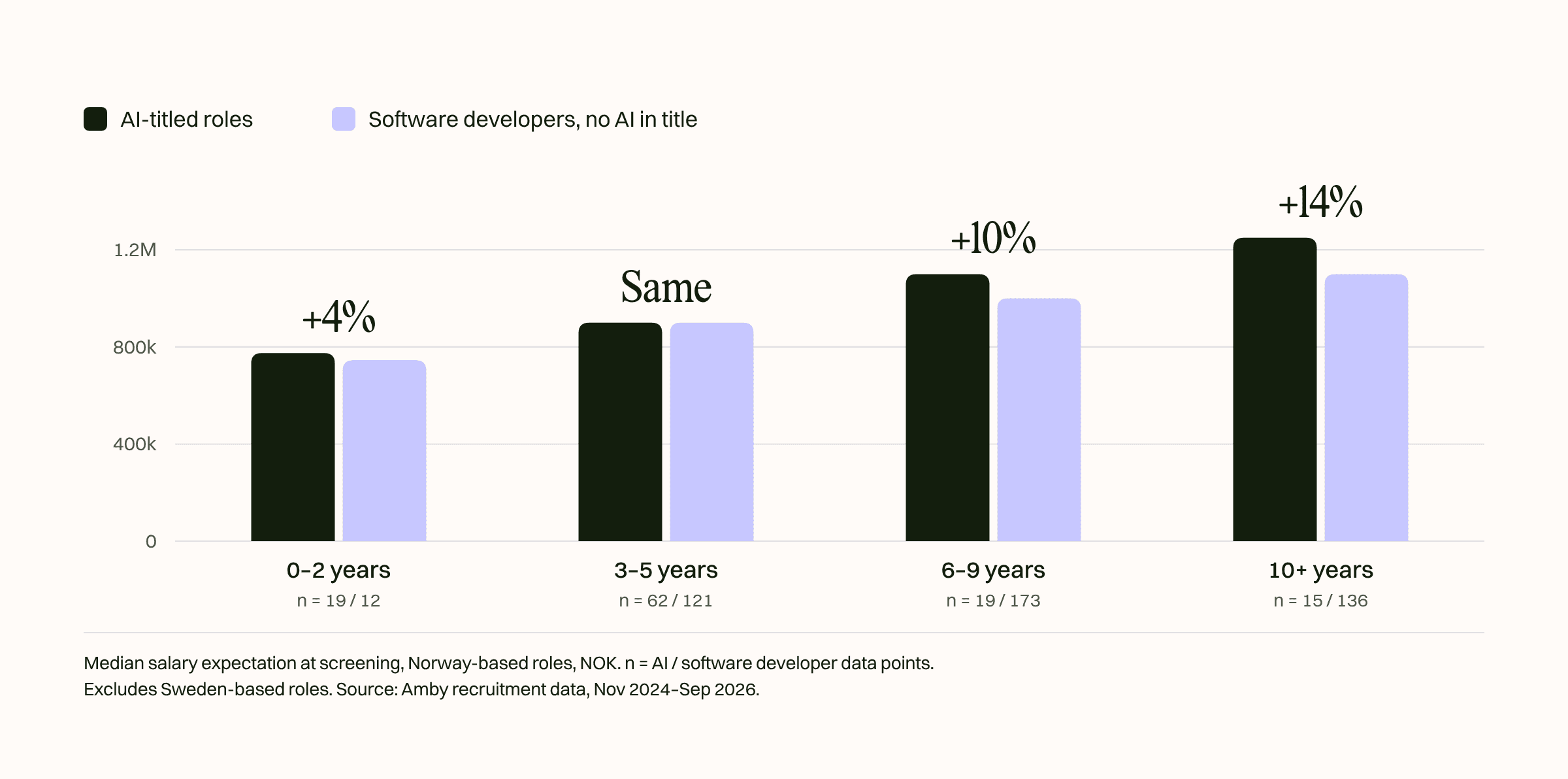
Median expected annual compensation in NOK. These are unadjusted comparisons within experience brackets.
0–2 years: AI-titled candidates asked for 775,000, against 745,000 for software developers. A gap of 4%.
3–5 years: Both groups asked for 900,000. No gap at all.
6–9 years: AI-titled candidates asked for 1,100,000, against 1,000,000 for software developers. A gap of 10%.
10+ years: AI-titled candidates asked for 1,250,000, against 1,100,000 for software developers. A gap of 14%.
At the same experience level, AI candidates never ask for less than software developers, and in most groups they ask for more. The premium was there all along. It was hidden in the overall numbers because the AI group is less experienced.
At first glance, it looks like the premium disappears entirely for candidates with three to five years of experience, before becoming more pronounced among senior professionals. But even within the same experience bracket, the candidates aren't necessarily equally experienced, and that can make a surprisingly big difference.
In the three-to-five-year group, for example, 40% of AI candidates have exactly three years of experience, compared with just 18% of software developers. So while both groups have the same median salary expectation of 900,000 NOK, the AI group is more concentrated towards the lower end of the experience range. It’s the same effect as in the overall numbers, just on a smaller scale.
Once we account for candidates' exact recorded experience rather than grouping everyone into broad brackets, the premium remains visible through much of the market. Among candidates with three to five years of experience, the adjusted AI premium is approximately 7%. For those with six to nine years, the estimate is around 5%, although the data is less conclusive in that group.
The largest estimated difference appears among candidates with ten or more years of experience, where AI-titled candidates have salary expectations approximately 14–15% higher than comparable software developers. There are relatively few observations at this level, however, and several come from the same recruitment processes, so we wouldn't treat that figure as a universal salary benchmark.
What the data suggests is that the AI premium doesn't suddenly appear once someone reaches senior level. It's visible across much of the experience range, with indications that it becomes more pronounced among the most experienced candidates. So when you compare like with like, AI talent costs more, not less.
And what are employers actually paying?
Of course, what candidates ask for and what companies ultimately pay aren't always the same thing. Looking specifically at completed hires, the median annual base salary for AI-titled roles was 975,000 NOK, compared with 950,000 NOK for software developers.
Among hires with fewer than three years of recorded experience, the median accepted base salary was 800,000 NOK for AI-titled roles and 750,000 NOK for software developers.
These are descriptive figures rather than experience-adjusted comparisons, so they shouldn't be interpreted as another calculation of the overall 7% premium. They do, however, offer a useful perspective on the salaries candidates ultimately receive, rather than simply what they hope to earn when entering a recruitment process.
Base salary isn't always the whole story
When companies budget for a new hire, base salary is usually the starting point, but it isn't necessarily the only part of the compensation package candidates consider. Equity, bonuses and other benefits can all influence how attractive an offer looks, particularly when companies are competing for people with specialized technical skills.
One thing we noticed in our data was that equity appeared relatively frequently in AI-related hires. Among recorded hires, 40% of AI-titled candidates had equity marked as part of their offer, compared with 26% of software developer hires. That may say something about who is hiring for AI roles, and when. Equity is most common in startups and early-stage companies, so the numbers suggest that many AI hires happen early, often among a company’s first 10–50 employees. In other words, if you’re offering equity to an AI hire, you’re probably hiring them early.
Equity means receiving some form of ownership in the company, often through shares or stock options. It's particularly common among startups and scale-ups, where the potential future value of company ownership can be part of the attraction for candidates.
But there's an important detail behind our numbers. All ten AI equity offers in our dataset came from just two robotics companies, and equity wasn't consistently documented across every hire. That means we can't conclude that AI roles generally come with equity more often, or that these percentages reflect the wider market.
What it does illustrate is how much the employer can influence the compensation package. A startup offering stock options and an established company offering a higher fixed salary may be competing for the same candidate, even though their offers look quite different on paper.
For companies planning to hire AI talent, that's worth keeping in mind. Understanding what other employers are offering, and what candidates value in a potential opportunity, can be just as important as knowing the typical base salary for a role.
Does having AI in the job title automatically mean higher pay?
Not necessarily, and this is where understanding the actual responsibilities of a role becomes particularly important.
We also explored how salary expectations compare in more narrowly defined roles, including fullstack developers with and without AI in their titles. Fullstack developers typically work across different parts of a software application, from the user-facing interface to the systems running behind it, and some may also integrate existing AI tools or language models into the products they build.
In our data, we couldn't establish a clear salary difference between fullstack roles with AI in the title and those without it. We saw a similarly inconclusive result when comparing data science roles with software developer roles. These comparisons are based on a limited number of recruitment processes, so we wouldn't use them to claim that AI-related skills in these areas carry no premium. But they do raise an interesting point about how broadly we tend to talk about AI talent.
A developer integrating an existing language model into a product and an engineer building, training or optimizing machine learning models may both work with AI, but the responsibilities and expertise required can be very different. The same goes for an AI transformation lead, whose work might focus on helping an organization adopt AI across teams rather than developing the underlying technology. All of these roles can have AI in the title, but they don't necessarily require the same skills, attract the same candidates or command the same compensation.
That's why starting with the job title alone can lead companies in the wrong direction when setting salary budgets. Before deciding how much to pay for an AI hire, it's worth understanding exactly what kind of expertise the role requires and how specialized that expertise really is.
Is the premium starting to change?
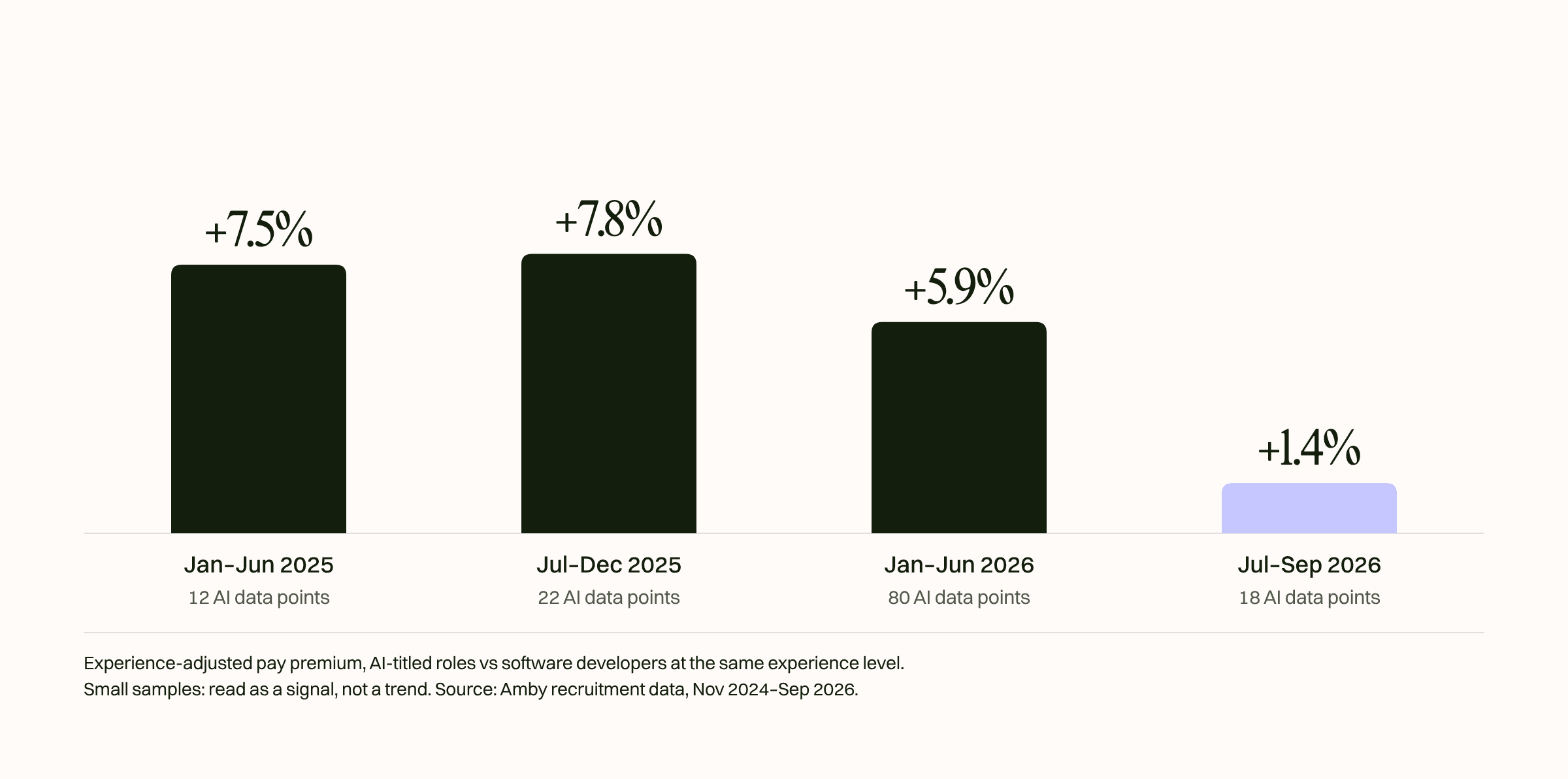
There's also an interesting development in our more recent data. In 2025, the experience-adjusted AI premium was approximately 7.1%, while in 2026, through September, it was 4.5%.
That might suggest the premium is getting smaller, but we'd be careful about drawing that conclusion just yet. The difference is within the statistical uncertainty of our analysis, meaning we can't confidently say whether it reflects a genuine shift in the market or simply differences in the candidates, employers and recruitment processes represented.
For now, the premium remains visible, and whether it continues to change is something we'll be interested in following as more data becomes available.
So, how should you budget for your next AI hire?
For companies planning to hire AI talent, our findings don't suggest ignoring the salary premium. They suggest being more deliberate about when and how to account for it.
Start with a comparable engineering salary, then account for the premium. Rather than creating an entirely separate salary scale for every role with AI in the title, start by looking at what you'd pay a software engineer with comparable experience. Our data suggests a premium of approximately 7% as a useful initial benchmark, before considering the specific responsibilities and requirements of the role.
Be prepared to pay more for highly experienced specialists. The premium appears particularly pronounced among candidates with ten or more years of relevant experience, where salary expectations were approximately 14–15% higher in our analysis. The sample is small, so it shouldn't be treated as a fixed rule, but it's worth recognizing that some experienced specialists may require additional budget.
Define the expertise you need before deciding what it should cost. Not every company needs someone who can build or train AI models from scratch. Sometimes the requirement is a strong software developer who knows how to integrate existing AI technology into a product, while other times you need deep expertise in machine learning, computer vision or AI infrastructure. Those are different hiring challenges, and they shouldn't automatically come with the same salary expectations.
Consider the full offer, not just the salary. Candidates may be comparing base salary, ownership opportunities, benefits, career development and the work itself. Understanding what competing employers offer can help you build a more attractive package without relying solely on a higher base salary.
The bottom line
AI talent does come with a salary premium. Our data puts it at roughly 7% when comparing AI-titled engineering roles with software developers at comparable levels of recorded experience, which is a meaningful difference, but not one that justifies treating every AI-related hire as if it belongs to an entirely different salary market.
The premium also isn't uniform. Experience and the type of role matter, and the most experienced candidates may command considerably more. At the same time, having AI in a job title doesn't necessarily tell you much about the complexity of the work or the expertise required.
For companies, the lesson is fairly straightforward. Rather than building a hiring budget around the assumption that AI talent is exceptionally expensive, start by understanding what you actually need someone to do, what experience that requires and what comparable talent costs.
Because the goal isn't to pay as little as possible for AI expertise. It's to pay for the expertise you actually need.
Hiring AI talent? Let's figure out what you actually need.
Whether you're hiring your first AI specialist or building out an entire technical team, we can help you define the role, understand the talent market and find the people you need.
Get in touch with Amby.
Author profile
Solvår Anine Nilssen Rusånes
Marketing and Campaign Specialist who works at the intersection of marketing, people and tech, and loves writing about it.

Ready? Let’s do it.
Get in touch to learn more about how we can help solve your talent needs.
Ready? Let’s do it.
Get in touch to learn more about how we can help solve your talent needs.
Ready? Let’s do it.
Get in touch to learn more about how we can help solve your talent needs.
What Does It Actually Cost to Hire AI Talent in Norway?
AI talent has a reputation for being expensive, but how much more does it actually cost to hire? We analysed our salary records from our recruitment processes to understand the AI salary premium in Norway, where it shows up, and what companies should consider when budgeting for their next AI hire.
AI talent has a reputation for being expensive. But how much more should companies actually expect to pay for someone working in AI compared with a traditional software developer?
As a recruitment partner, we've had a front-row seat to the AI hiring wave. Since 2024, we've recruited dozens of different roles with AI in the title, across different employers. AI developers, machine learning engineers, computer vision engineers and AI transformation leads, to name a few. Some at startups, others at companies you might not immediately associate with AI. And when companies start discussing these hires, one question tends to come up pretty quickly: What is this going to cost us?
It's a reasonable question, considering how much attention AI has received over the past few years and how frequently we hear about the shortage of people with the right expertise. Companies are investing in new capabilities, competition for experienced specialists can be intense, and there's a general assumption that hiring someone with AI in their job title means paying considerably more than you would for other technical talent.
We wanted to see how much of that assumption actually holds up, so we went into our own recruitment data. Between November 2024 and September 2026, our recruiters recorded 2,192 salary observations, covering both what candidates expected to earn during recruitment processes and the salaries people were ultimately hired at.
We compared engineering roles with AI in the title against software developer roles without it, accounting for differences in experience and other factors that could affect salary. And while the results confirm that there is an AI salary premium, they also tell a more nuanced story about where it comes from and how companies should think about it.
The short answer: Expect to pay around a 7% premium
Let's start with the headline. AI-titled engineering roles carry a salary premium of approximately 7% compared with software developer roles at a comparable level of recorded experience. To put that into perspective, if you're budgeting 900,000 NOK for a software developer, a 7% premium would mean approximately 63,000 NOK more per year. That's certainly worth accounting for, but it's not an entirely different salary market either.
Our analysis is based on 663 salary records from Norway-based recruitment processes, including 132 observations for AI-titled engineering roles and 531 for software developers. Rather than simply comparing average salaries, we accounted for differences in experience, when the salary was recorded, whether it represented a candidate's expectation or an accepted offer, and the type of recruitment assignment. The result was a premium of 6.6%, which we've rounded to approximately 7%.
We also tested the finding in several ways to see whether it held up. Matching AI candidates with developers who had similar experience in the same year produced a premium of around 6–7%, while removing any single employer from the analysis kept the result between approximately 6% and 8%. So although the exact size of the premium is uncertain, the overall finding is fairly consistent. AI-titled engineering roles do command higher compensation in our data, but the difference is considerably more modest than the hype surrounding AI salaries might suggest.
And perhaps more interestingly, that premium isn't immediately obvious when you first look at the numbers.
The surprising part: AI candidates actually ask for less
On average, yes: AI candidates ask for less than software developers. But that’s not because AI talent is cheaper. It’s because the AI candidates in our data have much less experience.
If we compare median salary expectations without accounting for experience, AI candidates appear to be the more affordable group. The median salary expectation for AI-titled candidates in our data was 950,000 NOK, compared with 1,000,000 NOK for software developers. That might seem strange given everything we've just said about the AI premium, but the difference becomes easier to understand when we look at the experience profiles of the two groups.
The median AI-titled candidate had four years of recorded experience in the relevant field, compared with seven years for software developers. And the differences become even more noticeable at either end of the experience spectrum. Only 13% of AI-titled candidates had ten or more years of relevant experience, compared with 31% of developers, while 17% of AI-titled candidates had fewer than three years, compared with just 3% of developers. In other words, the AI candidates in our data generally have fewer recorded years of relevant experience, which matters quite a bit when you're comparing salary. So the overall comparison mostly puts a less experienced AI candidate against a more experienced software developer.y expectations
There's also an important distinction in how we measure experience. Our recruiters record the number of years someone has worked in the area relevant to the role they're applying for, rather than their total professional experience. For example, a candidate that has spent ten years working as a software engineer but only three working directly with AI, they will be counted as having three years of experience within AI. That means the figures aren't necessarily a measure of how long someone has been working overall, and experience may not be recorded in exactly the same way for every candidate.
Still, the difference helps explain why comparing overall salaries can give a misleading impression. Salary expectations generally increase with experience, so a group with fewer recorded years in the relevant field can have a lower median salary even if candidates with comparable experience tend to ask for more. That is what happens here: the lower AI median reflects less experience, not lower pay expectations.
To get a better picture of what companies should actually expect to pay, we therefore need to compare candidates at similar experience levels.
Where does the AI salary premium actually show up?
When we divide candidates into experience groups, the picture flips. Here's what candidates in our Norway-based salary sample told our recruiters they expected to earn, grouped by their recorded years of experience.
Median expected annual compensation in NOK. These are unadjusted comparisons within experience brackets.
0–2 years: AI-titled candidates asked for 775,000, against 745,000 for software developers. A gap of 4%.
3–5 years: Both groups asked for 900,000. No gap at all.
6–9 years: AI-titled candidates asked for 1,100,000, against 1,000,000 for software developers. A gap of 10%.
10+ years: AI-titled candidates asked for 1,250,000, against 1,100,000 for software developers. A gap of 14%.
At the same experience level, AI candidates never ask for less than software developers, and in most groups they ask for more. The premium was there all along. It was hidden in the overall numbers because the AI group is less experienced.
At first glance, it looks like the premium disappears entirely for candidates with three to five years of experience, before becoming more pronounced among senior professionals. But even within the same experience bracket, the candidates aren't necessarily equally experienced, and that can make a surprisingly big difference.
In the three-to-five-year group, for example, 40% of AI candidates have exactly three years of experience, compared with just 18% of software developers. So while both groups have the same median salary expectation of 900,000 NOK, the AI group is more concentrated towards the lower end of the experience range. It’s the same effect as in the overall numbers, just on a smaller scale.
Once we account for candidates' exact recorded experience rather than grouping everyone into broad brackets, the premium remains visible through much of the market. Among candidates with three to five years of experience, the adjusted AI premium is approximately 7%. For those with six to nine years, the estimate is around 5%, although the data is less conclusive in that group.
The largest estimated difference appears among candidates with ten or more years of experience, where AI-titled candidates have salary expectations approximately 14–15% higher than comparable software developers. There are relatively few observations at this level, however, and several come from the same recruitment processes, so we wouldn't treat that figure as a universal salary benchmark.
What the data suggests is that the AI premium doesn't suddenly appear once someone reaches senior level. It's visible across much of the experience range, with indications that it becomes more pronounced among the most experienced candidates. So when you compare like with like, AI talent costs more, not less.
And what are employers actually paying?
Of course, what candidates ask for and what companies ultimately pay aren't always the same thing. Looking specifically at completed hires, the median annual base salary for AI-titled roles was 975,000 NOK, compared with 950,000 NOK for software developers.
Among hires with fewer than three years of recorded experience, the median accepted base salary was 800,000 NOK for AI-titled roles and 750,000 NOK for software developers.
These are descriptive figures rather than experience-adjusted comparisons, so they shouldn't be interpreted as another calculation of the overall 7% premium. They do, however, offer a useful perspective on the salaries candidates ultimately receive, rather than simply what they hope to earn when entering a recruitment process.
Base salary isn't always the whole story
When companies budget for a new hire, base salary is usually the starting point, but it isn't necessarily the only part of the compensation package candidates consider. Equity, bonuses and other benefits can all influence how attractive an offer looks, particularly when companies are competing for people with specialized technical skills.
One thing we noticed in our data was that equity appeared relatively frequently in AI-related hires. Among recorded hires, 40% of AI-titled candidates had equity marked as part of their offer, compared with 26% of software developer hires. That may say something about who is hiring for AI roles, and when. Equity is most common in startups and early-stage companies, so the numbers suggest that many AI hires happen early, often among a company’s first 10–50 employees. In other words, if you’re offering equity to an AI hire, you’re probably hiring them early.
Equity means receiving some form of ownership in the company, often through shares or stock options. It's particularly common among startups and scale-ups, where the potential future value of company ownership can be part of the attraction for candidates.
But there's an important detail behind our numbers. All ten AI equity offers in our dataset came from just two robotics companies, and equity wasn't consistently documented across every hire. That means we can't conclude that AI roles generally come with equity more often, or that these percentages reflect the wider market.
What it does illustrate is how much the employer can influence the compensation package. A startup offering stock options and an established company offering a higher fixed salary may be competing for the same candidate, even though their offers look quite different on paper.
For companies planning to hire AI talent, that's worth keeping in mind. Understanding what other employers are offering, and what candidates value in a potential opportunity, can be just as important as knowing the typical base salary for a role.
Does having AI in the job title automatically mean higher pay?
Not necessarily, and this is where understanding the actual responsibilities of a role becomes particularly important.
We also explored how salary expectations compare in more narrowly defined roles, including fullstack developers with and without AI in their titles. Fullstack developers typically work across different parts of a software application, from the user-facing interface to the systems running behind it, and some may also integrate existing AI tools or language models into the products they build.
In our data, we couldn't establish a clear salary difference between fullstack roles with AI in the title and those without it. We saw a similarly inconclusive result when comparing data science roles with software developer roles. These comparisons are based on a limited number of recruitment processes, so we wouldn't use them to claim that AI-related skills in these areas carry no premium. But they do raise an interesting point about how broadly we tend to talk about AI talent.
A developer integrating an existing language model into a product and an engineer building, training or optimizing machine learning models may both work with AI, but the responsibilities and expertise required can be very different. The same goes for an AI transformation lead, whose work might focus on helping an organization adopt AI across teams rather than developing the underlying technology. All of these roles can have AI in the title, but they don't necessarily require the same skills, attract the same candidates or command the same compensation.
That's why starting with the job title alone can lead companies in the wrong direction when setting salary budgets. Before deciding how much to pay for an AI hire, it's worth understanding exactly what kind of expertise the role requires and how specialized that expertise really is.
Is the premium starting to change?
There's also an interesting development in our more recent data. In 2025, the experience-adjusted AI premium was approximately 7.1%, while in 2026, through September, it was 4.5%.
That might suggest the premium is getting smaller, but we'd be careful about drawing that conclusion just yet. The difference is within the statistical uncertainty of our analysis, meaning we can't confidently say whether it reflects a genuine shift in the market or simply differences in the candidates, employers and recruitment processes represented.
For now, the premium remains visible, and whether it continues to change is something we'll be interested in following as more data becomes available.
So, how should you budget for your next AI hire?
For companies planning to hire AI talent, our findings don't suggest ignoring the salary premium. They suggest being more deliberate about when and how to account for it.
Start with a comparable engineering salary, then account for the premium. Rather than creating an entirely separate salary scale for every role with AI in the title, start by looking at what you'd pay a software engineer with comparable experience. Our data suggests a premium of approximately 7% as a useful initial benchmark, before considering the specific responsibilities and requirements of the role.
Be prepared to pay more for highly experienced specialists. The premium appears particularly pronounced among candidates with ten or more years of relevant experience, where salary expectations were approximately 14–15% higher in our analysis. The sample is small, so it shouldn't be treated as a fixed rule, but it's worth recognizing that some experienced specialists may require additional budget.
Define the expertise you need before deciding what it should cost. Not every company needs someone who can build or train AI models from scratch. Sometimes the requirement is a strong software developer who knows how to integrate existing AI technology into a product, while other times you need deep expertise in machine learning, computer vision or AI infrastructure. Those are different hiring challenges, and they shouldn't automatically come with the same salary expectations.
Consider the full offer, not just the salary. Candidates may be comparing base salary, ownership opportunities, benefits, career development and the work itself. Understanding what competing employers offer can help you build a more attractive package without relying solely on a higher base salary.
The bottom line
AI talent does come with a salary premium. Our data puts it at roughly 7% when comparing AI-titled engineering roles with software developers at comparable levels of recorded experience, which is a meaningful difference, but not one that justifies treating every AI-related hire as if it belongs to an entirely different salary market.
The premium also isn't uniform. Experience and the type of role matter, and the most experienced candidates may command considerably more. At the same time, having AI in a job title doesn't necessarily tell you much about the complexity of the work or the expertise required.
For companies, the lesson is fairly straightforward. Rather than building a hiring budget around the assumption that AI talent is exceptionally expensive, start by understanding what you actually need someone to do, what experience that requires and what comparable talent costs.
Because the goal isn't to pay as little as possible for AI expertise. It's to pay for the expertise you actually need.
Hiring AI talent? Let's figure out what you actually need.
Whether you're hiring your first AI specialist or building out an entire technical team, we can help you define the role, understand the talent market and find the people you need.
Get in touch with Amby.
Author profile
Solvår Anine Nilssen Rusånes
Marketing and Campaign Specialist who works at the intersection of marketing, people and tech, and loves writing about it.
Ready? Let’s do it.
Get in touch to learn more about how we can help solve your talent needs.
Ready? Let’s do it.
Get in touch to learn more about how we can help solve your talent needs.
Ready? Let’s do it.
Get in touch to learn more about how we can help solve your talent needs.